







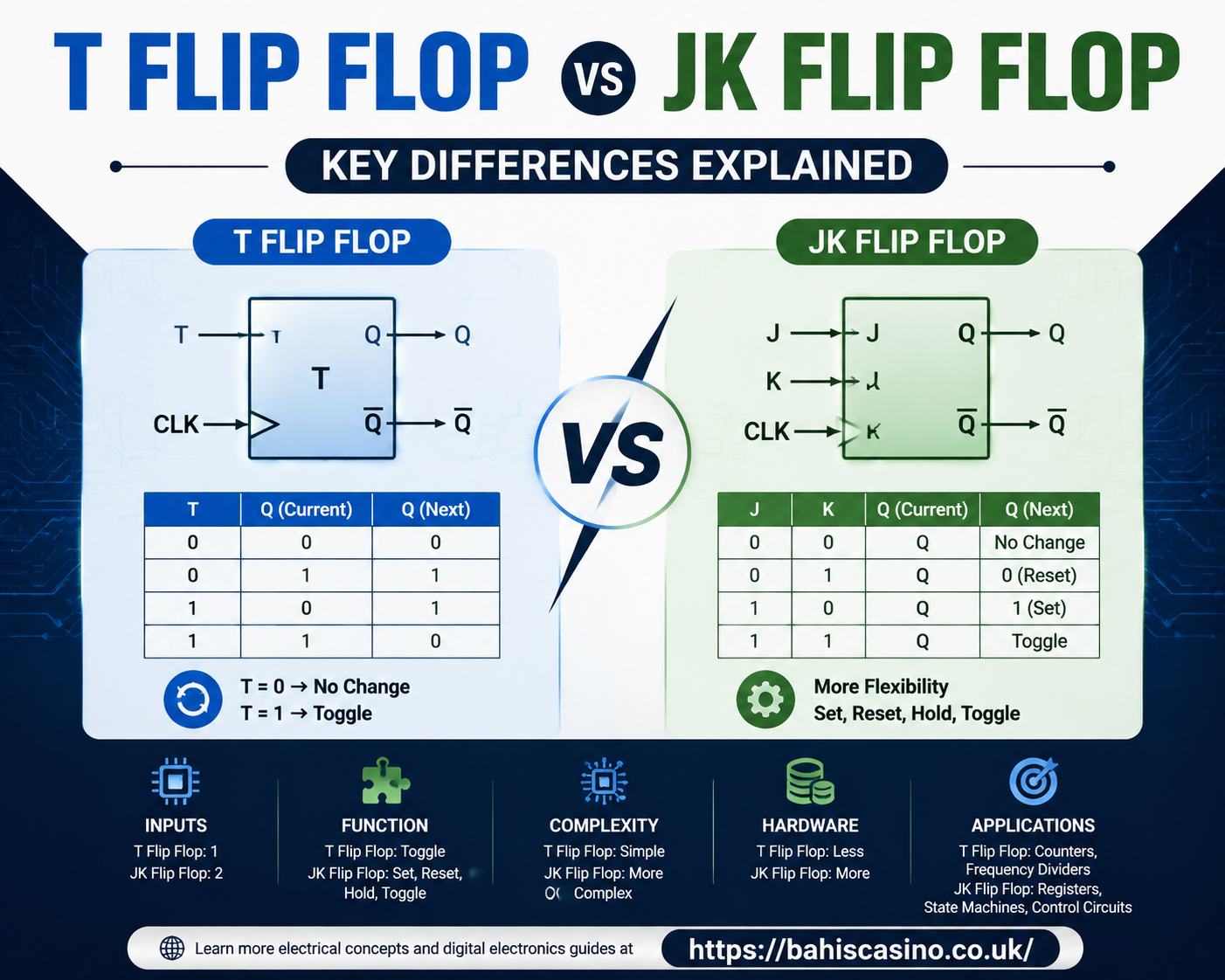
T Flip Flop vs JK Flip Flop Key Differences Explained
Digital electronics relies on flip-flops to store and control binary information in sequential circuits. Among the most commonly studied types are the T Flip Flop and the JK Flip Flop. Although both are used for memory storage and state transitions, they serve different purposes and operate in distinct ways.
Understanding the differences between these two flip-flops is essential for students, electronics enthusiasts, and engineers designing digital systems. Choosing the appropriate flip-flop can simplify circuit design, reduce hardware complexity, and improve overall system performance.
What Is a T Flip Flop?
A T Flip Flop, or Toggle Flip Flop, is a sequential logic device with a single input (T) and two outputs (Q and Q̅). It changes, or toggles, its output whenever the clock signal arrives while the T input is set to 1.
If the T input is 0, the flip-flop maintains its current state regardless of the clock pulse.
Because of its simple operation, the T Flip Flop is widely used in digital counters, frequency dividers, and timing circuits.
T Flip Flop Truth Table
| T | Current Q | Next Q |
|---|---|---|
| 0 | 0 | 0 |
| 0 | 1 | 1 |
| 1 | 0 | 1 |
| 1 | 1 | 0 |
The table shows that the output changes only when T equals 1.
What Is a JK Flip Flop?
A JK Flip Flop is an improved version of the SR flip-flop. It has two inputs:
- J (Set)
- K (Reset)
Unlike the SR flip-flop, the JK Flip Flop removes the invalid input condition. When both J and K are high, the output toggles instead of entering an undefined state.
This flexibility makes it one of the most widely used flip-flops in sequential circuit design.
JK Flip Flop Truth Table
| J | K | Current Q | Next Q |
| 0 | 0 | Q | No Change |
| 0 | 1 | Q | Reset (0) |
| 1 | 0 | Q | Set (1) |
| 1 | 1 | Q | Toggle |
T Flip Flop vs JK Flip Flop: Comparison Table
| Feature | T Flip Flop | JK Flip Flop |
| Number of Inputs | 1 | 2 |
| Main Function | Toggle | Set, Reset, Hold, Toggle |
| Complexity | Simple | More complex |
| Circuit Design | Easier | Slightly more complicated |
| Hardware Required | Less | More |
| Flexibility | Limited | Highly flexible |
| Common Applications | Counters, frequency dividers | Registers, counters, control circuits |
| Learning Difficulty | Easy | Moderate |
How They Work
T Flip Flop Operation
The T Flip Flop operates with one control input.
- T = 0 → Output remains unchanged.
- T = 1 → Output toggles on every clock pulse.
For example, if the output is initially 0:
- First clock pulse → 1
- Second clock pulse → 0
- Third clock pulse → 1
This alternating behavior makes it ideal for counting applications.
JK Flip Flop Operation
The JK Flip Flop offers four operating modes.
- J = 0, K = 0 → Hold current state.
- J = 0, K = 1 → Reset output.
- J = 1, K = 0 → Set output.
- J = 1, K = 1 → Toggle output.
Because it supports multiple functions, designers can use it in a wide range of digital systems.
Key Differences Between T Flip Flop and JK Flip Flop
1. Number of Inputs
A T Flip Flop has one input, making it straightforward to use.
A JK Flip Flop has two inputs, allowing more control over output behavior.
2. Functional Flexibility
The T Flip Flop performs only one primary action—toggling.
The JK Flip Flop can hold, reset, set, or toggle, making it significantly more versatile.
3. Circuit Complexity
T Flip Flops require fewer logic gates and are easier to implement.
JK Flip Flops involve more circuitry because they support multiple operations.
4. Hardware Cost
Since T Flip Flops have fewer components, they typically require less hardware.
JK Flip Flops generally consume slightly more hardware resources.
5. Applications
T Flip Flops are optimized for repetitive switching tasks.
JK Flip Flops are suitable for more advanced sequential logic designs.
Advantages of a T Flip Flop
- Very simple design
- Easy to understand
- Requires minimal hardware
- Excellent for binary counters
- Efficient frequency divider
Disadvantages of a T Flip Flop
- Limited functionality
- Only supports toggling
- Less flexible than other flip-flops
- Not suitable for complex control systems
Advantages of a JK Flip Flop
- Eliminates invalid input conditions
- Supports multiple operations
- Highly versatile
- Suitable for many digital circuits
- Reliable in sequential logic applications
Disadvantages of a JK Flip Flop
- More complex design
- Requires additional logic gates
- Slightly higher implementation cost
- Can experience race-around issues in level-triggered designs if not properly controlled
Practical Applications
Common Applications of T Flip Flop
- Binary counters
- Ripple counters
- Synchronous counters
- Frequency divider circuits
- Digital clocks
- Timing systems
Common Applications of JK Flip Flop
- Shift registers
- State machines
- Memory circuits
- Digital controllers
- Sequential logic systems
- General-purpose flip-flop implementations
Which Flip-Flop Should You Choose?
The choice depends on your application.
Choose a T Flip Flop when:
- You need a simple toggle operation.
- You are designing counters.
- Hardware simplicity is important.
- The circuit only requires alternating output states.
Choose a JK Flip Flop when:
- Multiple output operations are required.
- The circuit needs set, reset, and toggle capabilities.
- You are building complex sequential systems.
- Greater design flexibility is needed.
Can a JK Flip Flop Be Converted into a T Flip Flop?
Yes. A JK Flip Flop can function as a T Flip Flop by connecting the J and K inputs together and using them as a single T input.
When:
- J = K = 0 → No change
- J = K = 1 → Toggle
This configuration is commonly used in practical digital circuit design because it allows a JK Flip Flop to emulate the behavior of a T Flip Flop without requiring a separate component.
Real-World Example
Consider a digital clock that counts seconds.
Each incoming clock pulse must change the stored value in a predictable sequence. A T Flip Flop naturally toggles with every pulse, making it an excellent building block for binary counters.
On the other hand, a programmable traffic light controller must sometimes hold its state, switch to a new state, or reset based on control signals. A JK Flip Flop is better suited for this task because it supports all of these operations.
Frequently Asked Questions
1. What is the main difference between a T Flip Flop and a JK Flip Flop?
A T Flip Flop has one input and primarily performs a toggle operation, while a JK Flip Flop has two inputs and can hold, set, reset, or toggle its output.
2. Why is a T Flip Flop commonly used in counters?
Its output changes state with each qualifying clock pulse, making it ideal for binary counting and frequency division.
3. Can a JK Flip Flop replace a T Flip Flop?
Yes. By tying the J and K inputs together, a JK Flip Flop behaves like a T Flip Flop.
4. Which flip-flop is easier for beginners to understand?
The T Flip Flop is generally easier because it has only one input and a simple operating principle.
5. Does a JK Flip Flop have an invalid state?
No. Unlike the SR flip-flop, the JK Flip Flop eliminates the invalid state by toggling when both inputs are high.
6. Where are JK Flip Flops commonly used?
They are widely used in registers, state machines, sequential logic circuits, and digital control systems.
Conclusion
Both the T Flip Flop and the JK Flip Flop play important roles in digital electronics, but they are designed for different needs. The T Flip Flop offers a simple and efficient solution for applications that require output toggling, making it an excellent choice for counters and frequency dividers. In contrast, the JK Flip Flop provides greater flexibility by supporting set, reset, hold, and toggle operations, making it suitable for more sophisticated sequential circuits.
Understanding their working principles, truth tables, advantages, and practical applications helps designers choose the right flip-flop for a given project. While the T Flip Flop excels in simplicity and efficiency, the JK Flip Flop stands out for its versatility and broad applicability in modern digital system design.