






What Is a Straddle Carrier? Uses, Types, and Benefits
Modern ports handle millions of containers every year, and efficiency is everything. One of the most important machines behind this efficiency is the Straddle Carrier. If you’ve ever wondered how large shipping containers are moved, stacked, and organized with precision, this specialized vehicle plays a central role.
What Is a Straddle Carrier?
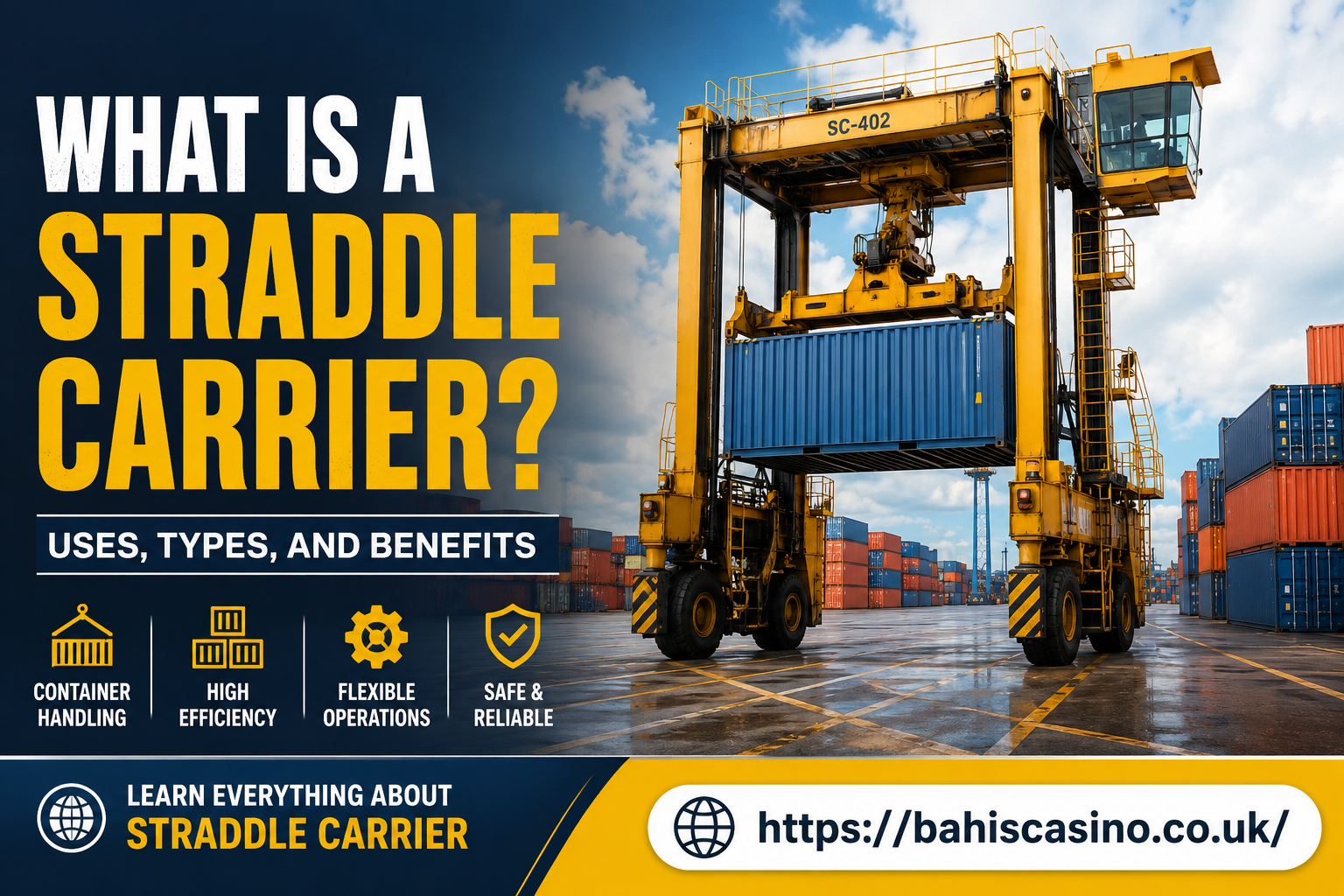
A straddle carrier is a large, wheeled vehicle designed to lift and transport shipping containers within ports and terminals. It gets its name from its ability to “straddle” a container—meaning it drives over the container and lifts it using a hoisting mechanism.
Unlike cranes that rely on fixed positions, a straddle carrier is mobile and can move containers directly from one location to another. This flexibility makes it one of the most efficient tools in container handling operations.
How Does a Straddle Carrier Work?
A straddle carrier operates by positioning itself over a container, attaching to it using a spreader, and lifting it off the ground. The vehicle then transports the container to another location, such as a storage yard or loading area.
Basic Operation Process
- Approach – The carrier drives over the container.
- Alignment – It aligns precisely using sensors or operator guidance.
- Lifting – The spreader locks onto the container and lifts it.
- Transport – The carrier moves the container to the destination.
- Placement – The container is lowered and positioned accurately.
Modern straddle carriers often include advanced control systems, GPS tracking, and automation features to improve precision and safety.
Types of Straddle Carriers
Straddle carriers come in several variations depending on power source, technology, and operational needs.
1. Diesel Straddle Carriers
These are the most common type and are powered by diesel engines. They are known for their strength and reliability in heavy-duty operations.
2. Electric Straddle Carriers
Electric models are becoming increasingly popular due to environmental concerns. They produce lower emissions and reduce fuel costs over time.
3. Hybrid Straddle Carriers
Hybrid versions combine diesel and electric systems to balance performance and energy efficiency.
4. Automated Straddle Carriers
Used in advanced terminals, these carriers operate without a driver. They rely on automation systems and software to move containers efficiently.
Uses of a Straddle Carrier
Straddle carriers are essential in many logistics and transportation environments.
Common Applications
- Container Ports – Moving containers between ships and storage areas
- Container Yards – Stacking and organizing containers
- Rail Terminals – Loading and unloading containers onto trains
- Intermodal Facilities – Transferring cargo between different transport modes
Practical Example
In a busy port, a ship unloads hundreds of containers. Instead of relying solely on cranes, straddle carriers transport these containers directly to storage stacks or trucks, reducing delays and improving workflow.
Benefits of Using a Straddle Carrier
Straddle carriers offer several advantages that make them a preferred choice in container handling.
1. High Mobility
They can move freely around terminals without needing tracks or rails.
2. Space Efficiency
Straddle carriers can stack containers vertically, maximizing storage space.
3. Operational Flexibility
They can perform multiple tasks, including lifting, transporting, and stacking.
4. Reduced Infrastructure Costs
Unlike rail-mounted systems, they do not require extensive infrastructure.
5. Improved Productivity
They streamline operations and reduce container handling time.
Straddle Carrier vs Reach Stacker
Understanding how a straddle carrier compares to other equipment can clarify its role.
| Feature | Straddle Carrier | Reach Stacker |
|---|---|---|
| Mobility | High | Moderate |
| Stacking Height | High | Medium |
| Space Efficiency | Excellent | Good |
| Flexibility | Very High | Moderate |
| Cost | Higher initial cost | Lower initial cost |
A reach stacker is better for smaller operations, while a straddle carrier excels in large-scale container terminals.
Key Components of a Straddle Carrier
To better understand how it functions, it helps to know its main parts.
Core Components
- Frame Structure – Supports the entire machine
- Spreader – Grips and lifts containers
- Engine or Motor – Powers the vehicle
- Wheels and Suspension – Enable movement and stability
- Operator Cabin – Provides control and visibility
Each component works together to ensure safe and efficient operation.
Safety Considerations
Operating a straddle carrier requires strict safety protocols.
Important Safety Measures
- Regular maintenance and inspections
- Operator training and certification
- Use of sensors and collision-avoidance systems
- Clear communication in busy terminals
Safety is critical due to the size and weight of containers being handled.
Future Trends in Straddle Carrier Technology
The logistics industry continues to evolve, and straddle carrier are no exception.
Emerging Trends
- Increased automation and autonomous systems
- Greater adoption of electric and eco-friendly models
- Integration with smart port technologies
- Enhanced data tracking and performance monitoring
These advancements aim to improve efficiency while reducing environmental impact.
Frequently Asked Questions
1. What is a straddle carrier used for?
A straddle carrier is used to lift, transport, and stack shipping containers in ports, terminals, and logistics facilities.
2. How high can a straddle carrier stack containers?
Most straddle carriers can stack containers up to three or four high, depending on the model.
3. Is a straddle carrier better than a crane?
It depends on the application. Cranes are ideal for loading ships, while straddle carriers are better for moving containers within terminals.
4. Are straddle carriers automated?
Some modern straddle carriers are fully automated, especially in advanced container terminals.
5. What powers a straddle carrier?
They can be powered by diesel engines, electric motors, or hybrid systems.
6. How fast can a straddle carrier move?
Speeds vary, but most operate at moderate speeds to ensure safety and precision.
7. Why are straddle carriers important in logistics?
They improve efficiency, reduce handling time, and optimize space in container operations.
Conclusion
A straddle carrier is a cornerstone of modern container handling, offering unmatched flexibility, efficiency, and performance in port and logistics operations. Its ability to lift, transport, and stack containers independently makes it an essential tool in managing global trade.
As technology advances, straddle carriers are becoming smarter, cleaner, and more efficient. Whether powered by diesel, electricity, or automation systems, they continue to play a vital role in keeping supply chains moving smoothly.