






Learning poker can feel overwhelming at first. With dozens of rules, hand rankings, betting terms, and strategic decisions to understand, many beginners struggle to know where to start. A well-structured poker cheat sheet can simplify the learning process by putting the most important information in one easy-to-follow guide.
Whether you want to play casual home games with friends or build a stronger foundation for online poker, understanding the basics is essential. A good poker cheat sheet helps new players remember hand values, understand betting actions, recognize common mistakes, and make better decisions at the table.
This beginner-focused guide explains the key elements every new player should know, including poker hand rankings, basic rules, starting hand selection, betting strategies, and practical tips to improve your game faster.
What Is a Poker Cheat Sheet?
A poker cheat sheet is a quick-reference guide that summarizes the most important information players need during a poker game. It is especially useful for beginners who are still learning the rules and strategies.
Instead of memorizing everything at once, new players can use a cheat sheet to quickly check important details such as:
- Poker hand rankings
- Betting actions
- Common poker terms
- Starting hand recommendations
- Basic strategy principles
- Common mistakes to avoid
A poker cheat sheet does not replace experience, but it provides a strong foundation that allows beginners to learn faster and play with more confidence.
Understanding Poker Hand Rankings
The first step in learning poker is knowing which hands are stronger than others. Every decision at the table depends on understanding hand strength.
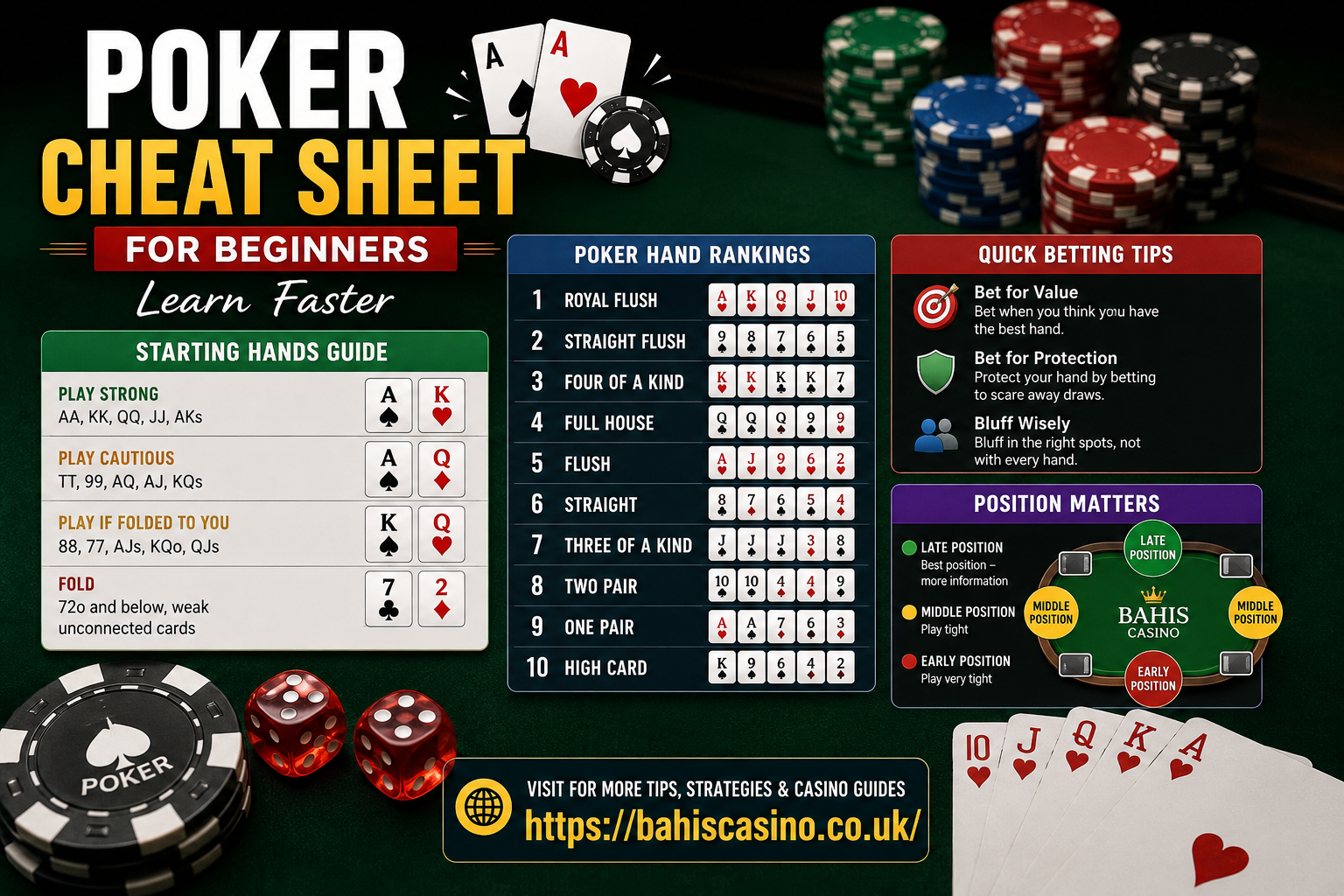
Here is the standard poker hand ranking from strongest to weakest:
| Rank | Hand | Description |
|---|---|---|
| 1 | Royal Flush | Ace-high straight flush (A-K-Q-J-10 of the same suit) |
| 2 | Straight Flush | Five consecutive cards of the same suit |
| 3 | Four of a Kind | Four cards with the same value |
| 4 | Full House | Three of a kind combined with a pair |
| 5 | Flush | Five cards of the same suit |
| 6 | Straight | Five consecutive cards of different suits |
| 7 | Three of a Kind | Three cards with the same value |
| 8 | Two Pair | Two different pairs |
| 9 | One Pair | Two cards with the same value |
| 10 | High Card | The highest single card when no combination is made |
Beginners should practice recognizing these combinations quickly. Knowing hand rankings without hesitation helps players focus more on strategy.
Basic Poker Rules Beginners Need to Know
Most beginner poker players start with Texas Hold’em, the most popular poker variation worldwide.
In Texas Hold’em:
- Each player receives two private cards called hole cards.
- Five community cards are placed face-up on the table.
- Players create the best possible five-card hand using their hole cards and community cards.
- Players compete through several betting rounds.
- The player with the strongest hand, or the player who makes others fold, wins the pot.
The betting rounds include:
- Pre-flop: After players receive their hole cards.
- Flop: Three community cards are revealed.
- Turn: A fourth community card is added.
- River: The final community card is revealed.
- Showdown: Remaining players reveal their hands.
Understanding this structure is one of the most important parts of any beginner poker cheat sheet.
Poker Actions Every Beginner Should Understand
Poker involves several common actions. Knowing what each action means helps players make better decisions.
| Action | Meaning |
|---|---|
| Fold | Give up your hand and leave the current round |
| Check | Pass the action without betting when no bet exists |
| Call | Match the current bet |
| Raise | Increase the amount of the current bet |
| Bet | Put chips into the pot first |
| All-in | Bet all remaining chips |
New players often lose chips because they do not understand when to use these actions. Good poker requires knowing not only your cards but also how and when to use each move.
Starting Hand Selection: The First Major Skill
One of the biggest beginner mistakes is playing too many hands. Strong poker players understand that patience is valuable.
Your starting cards determine many of your future decisions. Strong starting hands often include:
- Pocket Aces (AA)
- Pocket Kings (KK)
- Pocket Queens (QQ)
- Ace-King suited (AK suited)
- Ace-Queen suited (AQ suited)
- High pairs and strong connected cards
Weak hands can create difficult situations, especially when facing aggressive opponents.
A simple beginner strategy is:
- Play stronger hands more often.
- Avoid unnecessary risks with weak cards.
- Consider your position before entering a pot.
The Importance of Poker Position
Position refers to where you sit at the table compared with the dealer button. It affects how much information you have before making decisions.
Later positions are usually more valuable because you can observe what other players do first.
Common Poker Positions
| Position | Description |
|---|---|
| Early Position | Players act first and have less information |
| Middle Position | A balanced position with moderate information |
| Late Position | Players act later and can make more informed decisions |
| Button | The strongest position because it acts last after the flop |
A beginner poker cheat sheet should always include position because it strongly influences strategy.
Basic Betting Strategy for New Players
Poker is not only about having good cards. Betting decisions are equally important.
Beginners should focus on these basic principles:
Avoid Playing Every Hand
Many new players stay involved because they want to see every card. Professional players often fold frequently because they wait for better opportunities.
Understand Pot Odds and Risk
Before calling a bet, consider whether the possible reward justifies the cost. This concept becomes more important as players develop their skills.
Avoid Emotional Decisions
A common mistake is playing aggressively after losing a big hand. This is called “tilt.”
Good players stay patient and make decisions based on logic rather than frustration.
Common Beginner Poker Mistakes
A poker cheat sheet should not only explain what to do but also what to avoid.
Playing Too Many Hands
Weak starting hands often lead to difficult decisions later.
Ignoring Position
A strong hand in one position may become weaker in another.
Bluffing Too Often
Bluffing is part of poker, but beginners often use it incorrectly. Successful bluffing requires understanding opponents and situations.
Focusing Only on Your Own Cards
Poker is also about reading the table, analyzing betting patterns, and understanding opponent behavior.
Chasing Losses
Trying to quickly recover lost chips often leads to bigger mistakes.
Essential Poker Terms Beginners Should Learn
Understanding poker vocabulary makes learning easier.
| Term | Meaning |
|---|---|
| Pot | The total chips being played for |
| Blinds | Forced bets before cards are dealt |
| Hole Cards | Private cards given to each player |
| Community Cards | Shared cards placed on the table |
| Showdown | Final hand comparison |
| Bluff | Betting with a weaker hand to make opponents fold |
| Position | Your place relative to the dealer |
How a Poker Cheat Sheet Helps You Improve Faster
A beginner-friendly poker cheat sheet creates a simple learning path.
It helps players:
- Memorize important rules faster.
- Recognize strong and weak hands.
- Make fewer beginner mistakes.
- Understand basic strategy concepts.
- Build confidence during games.
However, improvement comes from combining knowledge with practice. Reviewing your decisions after each session can help identify areas for growth.
Simple Practice Plan for New Poker Players
A structured approach can speed up learning.
Learn Hand Rankings
Make sure you can identify every poker hand quickly.
Practice Starting Hand Selection
Learn which hands are generally worth playing.
Study Position
Understand why acting later provides an advantage.
Review Your Games
Think about important decisions and what you could improve.
Continue Learning Strategy
Poker is a skill game where even experienced players continue improving.
Frequently Asked Questions
What is the purpose of a poker cheat sheet?
A poker cheat sheet provides beginners with a quick reference for hand rankings, rules, terms, and basic strategies. It helps players learn important concepts faster.
What should a beginner poker cheat sheet include?
A useful poker cheat sheet should include hand rankings, betting actions, starting hand advice, poker positions, and common terminology.
What is the strongest hand in poker?
The strongest standard poker hand is a royal flush, which consists of Ace, King, Queen, Jack, and Ten of the same suit.
Is poker easy for beginners to learn?
The basic rules of poker are easy to understand, but mastering strategy takes time, practice, and experience.
Should beginners bluff often in poker?
Beginners should avoid excessive bluffing. It is better to focus on strong fundamentals, hand selection, and understanding opponents.
What is the best poker game for beginners?
Texas Hold’em is usually considered the best starting point because it has simple rules and is widely played.
Can a poker cheat sheet make me a better player?
A poker cheat sheet can improve your understanding of the game, but becoming a stronger player requires practice, strategy study, and experience.
Conclusion
A poker cheat sheet is one of the most useful tools for beginners who want to understand poker fundamentals quickly. By learning hand rankings, basic rules, betting actions, and strategic concepts, new players can build confidence and avoid common mistakes.
The key to improving at poker is combining knowledge with practice. Use a cheat sheet as your foundation, stay patient, study your decisions, and continue developing your skills over time. With the right approach, beginners can learn faster and enjoy the game with a much stronger understanding of how poker works.