







How Many Rows in Solitaire? Standard Setup Explained
If you’ve ever asked, “How Many Rows in Solitaire?”, you’re not alone. It’s one of the most common questions new players have when learning the classic card game. Understanding the correct layout is essential because every game starts with the same standard arrangement, and setting it up properly ensures you can play according to the official rules.
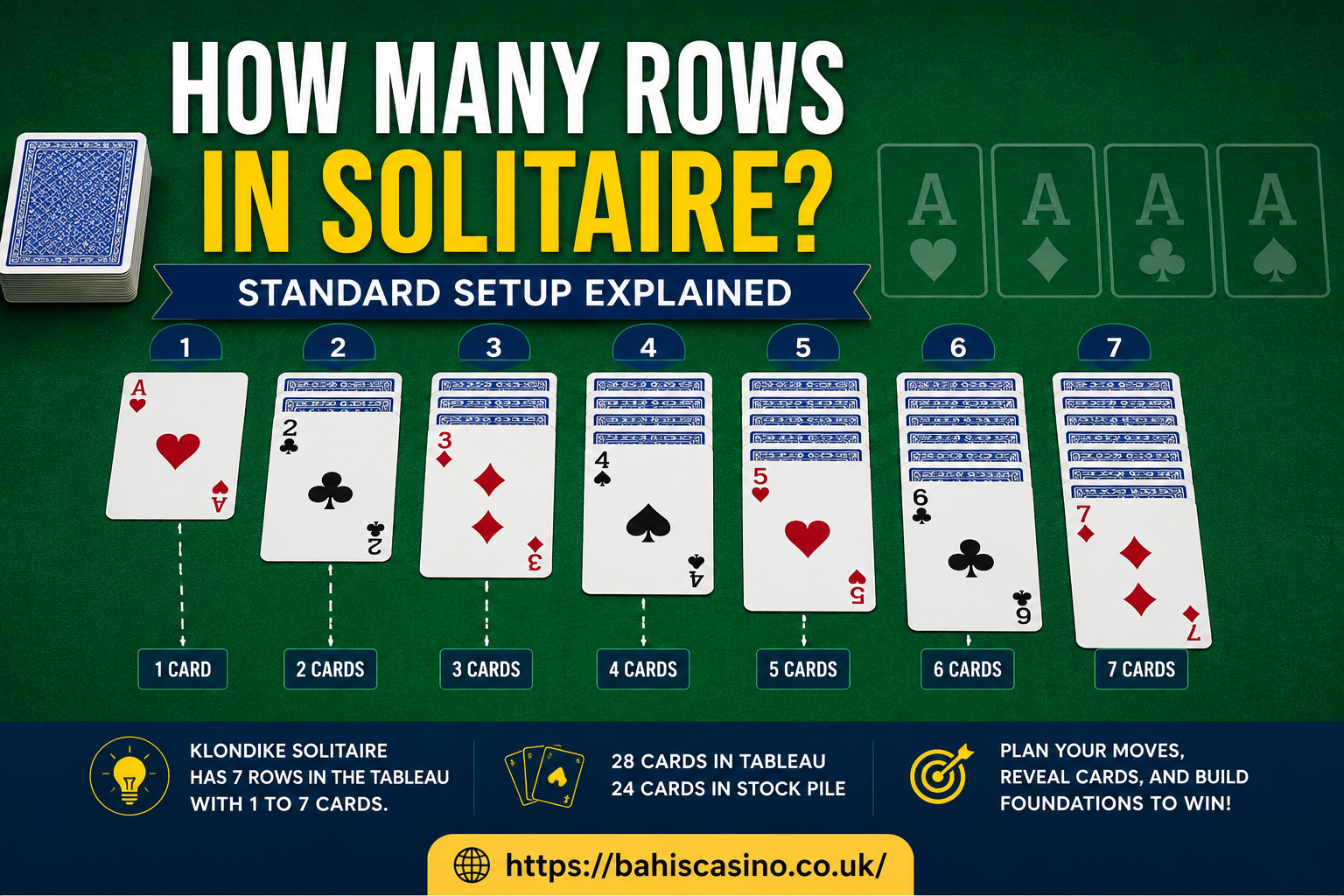
In classic Klondike Solitaire, the tableau consists of seven rows arranged in a specific pattern. Each row contains a different number of cards, creating the familiar staircase layout seen in physical card games and digital versions alike.
How Many Rows in Solitaire?
The answer is simple:
Classic Klondike Solitaire has seven rows.
These seven rows form the tableau, which is the main playing area where most of the game takes place.
Each row contains one more card than the previous row.
| Row | Number of Cards | Face-Up Cards |
|---|---|---|
| 1 | 1 | 1 |
| 2 | 2 | 1 |
| 3 | 3 | 1 |
| 4 | 4 | 1 |
| 5 | 5 | 1 |
| 6 | 6 | 1 |
| 7 | 7 | 1 |
Only the top card in each row starts face up. Every card underneath remains face down until it becomes uncovered during gameplay.
This arrangement creates the familiar cascading pattern that players recognize in almost every version of Solitaire.
Understanding the Standard Solitaire Setup
A standard deck contains 52 cards.
Before the game begins, the cards are divided into two main sections:
- Tableau: 28 cards arranged in seven rows.
- Stock pile: The remaining 24 cards.
The stock pile is placed face down and is used when no more moves are available on the tableau.
Along with these areas, there are four empty foundation piles, where cards are eventually organized by suit from Ace through King.
How to Deal the Seven Rows
Setting up Solitaire correctly takes only a minute.
Follow these steps:
- Place one card face up in the first row.
- Deal two cards in the second row, leaving only the top card face up.
- Continue this pattern until the seventh row contains seven cards.
- Place the remaining 24 cards face down to create the stock pile.
- Leave space for the four foundation piles above the tableau.
How Many Rows in Solitaire, The completed tableau should look like a staircase, with each row extending one card farther than the row before it.
Why Does Solitaire Use Seven Rows?
The seven-row design creates a balanced game that combines luck and strategy.
With seven rows:
- Players have several possible moves from the beginning.
- Hidden cards gradually become available.
- Decisions become increasingly strategic as more cards are revealed.
- The game remains challenging without being overly complex.
This structure has helped make Klondike Solitaire one of the most popular single-player card games in the world.
How Many Cards Are in Each Row?
The number of cards increases by one in each successive row.
| Tableau Row | Total Cards |
|---|---|
| First | 1 |
| Second | 2 |
| Third | 3 |
| Fourth | 4 |
| Fifth | 5 |
| Sixth | 6 |
| Seventh | 7 |
Adding them together gives:
1 + 2 + 3 + 4 + 5 + 6 + 7 = 28 cards
These 28 cards form the complete tableau.
Face-Up vs. Face-Down Cards
At the start of the game:
- Seven cards are face up.
- Twenty-one cards remain face down.
As you move cards during play, hidden cards become exposed. Revealing these hidden cards is often the key to solving the game successfully.
Many experienced players prioritize moves that uncover face-down cards because doing so creates more opportunities later in the game.
What Is the Tableau?
The tableau is the central playing area where cards are moved and organized.
Its main purposes include:
- Building descending sequences.
- Alternating red and black suits.
- Revealing hidden cards.
- Freeing spaces for Kings.
- Preparing cards for the foundation piles.
Nearly every strategic decision in Solitaire happens within the tableau.
The Other Parts of a Solitaire Game
Besides the seven rows, a standard game also includes:
| Area | Purpose |
|---|---|
| Tableau | Main playing area |
| Stock | Remaining undealt cards |
| Waste | Cards drawn from the stock |
| Foundation | Four piles built by suit from Ace to King |
Understanding each area makes learning the rules much easier.
Basic Rules for Moving Cards
Once the game begins, players follow several simple rules:
- Build cards in descending order.
- Alternate red and black colors.
- Move complete sequences when possible.
- Only Kings can occupy empty tableau columns.
- Begin foundation piles with Aces.
- Build foundations upward by suit until each reaches the King.
Mastering these rules is more important than memorizing advanced strategies.
Common Beginner Mistakes
Many new players make the same setup and gameplay errors.
Using the Wrong Number of Rows
The standard game always uses seven rows.
Adding or removing rows changes the game completely.
Turning Too Many Cards Face Up
Only the top card of each row should be face up initially.
Forgetting the Stock Pile
After dealing the tableau, exactly 24 cards remain in the stock.
Ignoring Hidden Cards
Players often focus on obvious moves instead of uncovering hidden cards. Revealing face-down cards usually leads to better long-term opportunities.
Solitaire Variations Use Different Layouts
Although Klondike uses seven rows, other Solitaire games have different setups.
| Solitaire Variation | Rows or Columns |
|---|---|
| Klondike | 7 |
| Spider Solitaire | 10 |
| FreeCell | 8 |
| Yukon | 7 |
| Forty Thieves | 10 |
This is why answers can differ depending on which version of Solitaire someone is playing.
When people simply ask, “How many rows in Solitaire?”, they are almost always referring to Klondike Solitaire, the classic version included with many computers and mobile apps.
Tips for Winning More Often
Understanding the setup is only the beginning. These tips can improve your chances of success:
- Reveal face-down cards as early as possible.
- Avoid moving cards to the foundation too quickly if they may still be needed in the tableau.
- Empty a tableau column only when you have a King ready to move into it.
- Think several moves ahead instead of making the first available move.
- Check all possible moves before drawing from the stock.
Good Solitaire players balance immediate gains with long-term planning.
Why the Standard Setup Matters
The seven-row arrangement isn’t arbitrary. It creates a game that rewards observation, patience, and careful decision-making.
A correct setup ensures:
- Every game begins fairly.
- Rules remain consistent.
- Strategy plays a meaningful role.
- Players can compare games and techniques using the same standard format.
Whether you’re learning for the first time or returning after years away, starting with the proper layout gives you the best playing experience.
Frequently Asked Questions
1. How many rows are in standard Solitaire?
Standard Klondike Solitaire uses seven rows in the tableau.
2. How many cards are dealt into the tableau?
The tableau contains 28 cards arranged across seven rows.
3. How many cards remain after dealing?
After dealing the tableau, 24 cards remain in the stock pile.
4. Why is only one card face up in each row?
Only the top card starts face up to create hidden information and strategic gameplay as more cards are revealed.
5. Do all Solitaire games have seven rows?
No. While Klondike uses seven rows, games such as Spider Solitaire and FreeCell use different layouts.
6. Can I play Solitaire with a regular deck of cards?
Yes. A standard 52-card deck is all you need to play classic Klondike Solitaire.
7. What is the tableau in Solitaire?
The tableau is the main playing area where cards are arranged into seven rows and moved according to the game’s rules.
Conclusion
The answer to “How Many Rows in Solitaire?” is straightforward: classic Klondike Solitaire uses seven rows arranged in a staircase pattern. These rows contain a total of 28 cards, with only the top card in each row facing up and the remaining 24 cards placed in the stock pile.
Knowing the correct setup is the foundation of learning Solitaire. Once you understand how the tableau is built, the movement rules, and the purpose of each area of the game, you’ll be ready to play with confidence. Whether you’re using a physical deck or a digital app, mastering the standard seven-row layout is the first step toward becoming a better Solitaire player.